

Latest news, alerts, and events.
Latest news, alerts, and events.
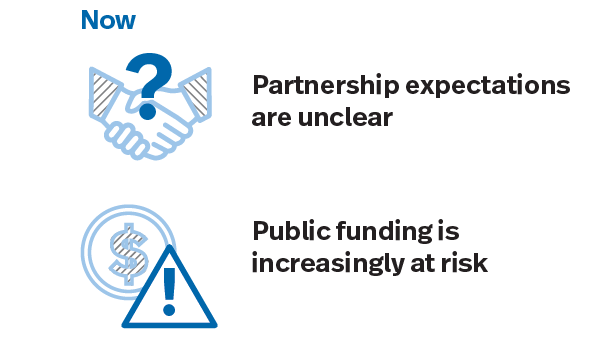
In August 2025, after Congress passed HR1., the tax overhaul bill, and all the advocacy that went along with it began to die down, we started to notice a strange quiet taking over Alaska’s nonprofit sector.
Maybe it also was happening beyond our borders, but regardless, it was a noticeable absence of noise in the wake of vocal disbelief, clear outrage, and loud dissent, not just to the tax implications for the people nonprofits serve every day, but to all the federal policy and funding changes that had preceded the bill.
While the new bill contained some potential positive opportunities, we knew even then that this quiet was not necessarily acceptance of a new normal, nor acceptance of what is happening to nonprofit funding and policy. Instead, we interpreted it as “heads down, get to work, persevere” because this is generally how nonprofit teams work. We simply deal with what is in front of us and get to work. But in this case, this silence felt different, and we were worried that a head-down, get-to-work approach could mean more burnout, less collaboration, less support, fewer creative solutions, and just less of everything that allows us to thrive, not just survive. When we asked, again and again, during the remaining months of 2025, “what do you need,” we heard again and again, “just help us feel less alone.” This only underscored our worry and confirmed that the board and staff of our organizations were living in collective silence.
So, what led to this silence? It wasn’t just the tax overhaul but a year of life that looked like a winding, twisting road of uncertainty in which the rules of play changed without warning causing our heads to turn in every direction to process each new blow of unexpected and often devastating or uncertain or contradictory news. Threats to funding through impoundment, recission, delay, and attacks on nonprofits’ nonpartisanship started and continue even for those who received no federal or government support. Pile on lawsuits, legal stays, government shutdowns, massive federal staffing changes, congressional hearings around the role of nonprofits, and more. It meant that every day, and even today, high stress and great instability were becoming the norm not just for nonprofits but for the state, local governments, tribes, and everyday Alaskans. And, we knew, as you do, that this was just the beginning.
You may recall that in January 2025, following the first Presidential Executive Order canceling all funding to every nonprofit across the country, we launched a survey that asked “what if all federal funds were pulled out of Alaska’s nonprofits?” The response was staggering and the results reflected both hard facts and deep worry. I refer to this report as a “worst case” picture for Alaska because it demonstrated the critical role of federal funds in operating the core programs that benefit Alaskans, along with the impacts if funds are withdrawn. For example, services in jeopardy include those providing a basic safety net (food, housing, health care), or childcare and youth safety, or suicide prevention. At risk, too, are programs in education, the arts, cultural preservation, and science and wildlife research. And, importantly, we could lose the means to protect the health and individual safety of Alaskans, especially for the most vulnerable.
If the scenarios noted in the report were to become true, which is a very real possibility, the results for Alaskans would be widespread and, in some cases, catastrophic. I urge you to read the report in full to understand what is at stake, not to get stuck in it or feel more overwhelmed by it, but to be inspired to take steps now to work on your financial and operational scenario plans so you and your team will know your next best steps if the funding goes away.
Thankfully, that executive order is currently being challenged in federal court and there is a stay in place to keep funding coming. Still, this is not over, and we continue to monitor it as it moves, we hope, toward the right conclusion, that the federal government and nonprofits have a social contract embedded in our democratic principles which provides for a relationship between the government’s responsibilities to care for the people of this country and nonprofit’s ability to delivery on those promises as “on the ground” and “in the work” partners.
And in our state, this social contract, while not perfect, is exactly the system we use to serve Alaskans. We have proven as a sector to be essential partners over and over again as we all strive to serve Alaskans, and Alaskans have relied on nonprofits for safety nets and quality of life. Nonprofits have proven over time that we operate efficiently and transparently, leverage philanthropy, earned revenue, and volunteers, create economies of scale in a lightly populated state, and show that as a partner we save government, at every level, time, money, and public resources.
Fast forward to 2026. Through the work and commitments, the silence persisted. So to learn more about how nonprofits were truly doing, we reached out again. This time, we surveyed those deeply touched by federal policy and funding changes either directly or through the State of Alaska. We also partnered with The Alaska Community Foundation, which had recently put out a call for funding to those impacted and used their data to better understand the direct impact.
While smaller in scope, our sample was representative in both geography and budget size for Alaska’s nonprofits. And because we were checking in on impact, it does skew to those who receive federal funding in some form or amount.
Most of the findings that I will share are likely not a surprise, but the one that caught and kept our attention is this: The silence, as we suspected, is not a symptom of lack of commitment. In fact, despite the impacts that have already happened and those that are anticipated, nonprofit teams are still just as committed to mission; just as determined to do the best they can with what they have; just as driven to get to work; and just as optimistic that the work matters. This is resilience, and this is the positive energy in the undercurrent of the silence.
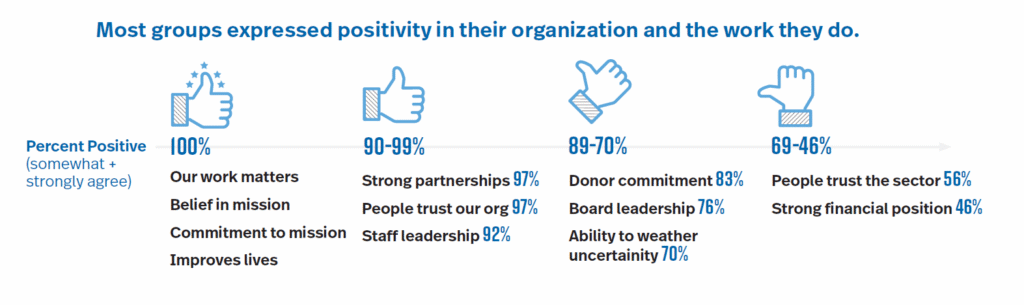
Less surprising but important to know is that the silence is also indicative of ongoing challenges with more to come.
When we asked about current impact, the vast majority noted cancellation of funding which has led a cut in programs and services. Not surprisingly, it has also created a need for new funding and increased uncertainty as demand for services continued to increase. Some also noted a new set of challenges, those setting their mission-based services and legal standings in opposition to new federal mandates.
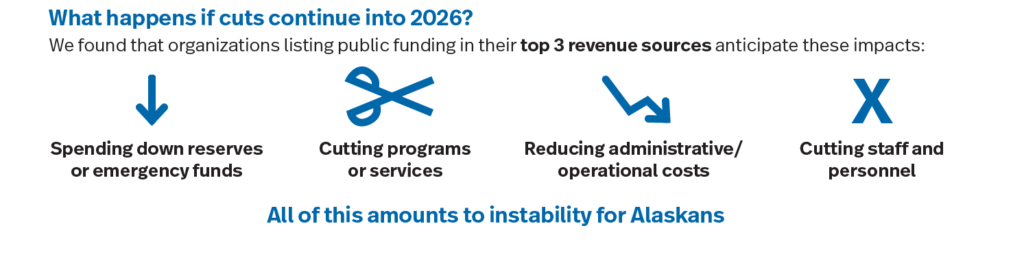
For organizations who ranked public funding in their top three revenue sources, 2026 is set to be a more difficult year to deliver service than 2025. These organizations anticipate needing to cut programs or services, reduce administrative/operational costs, and cut staff/personnel and spend down reserves or emergency funds completely. Many do not have those funds, and those who did said they held fewer than six months in reserve. All these actions will lead to greater instability for Alaskans and more pressure on local and state government and private investment to respond.
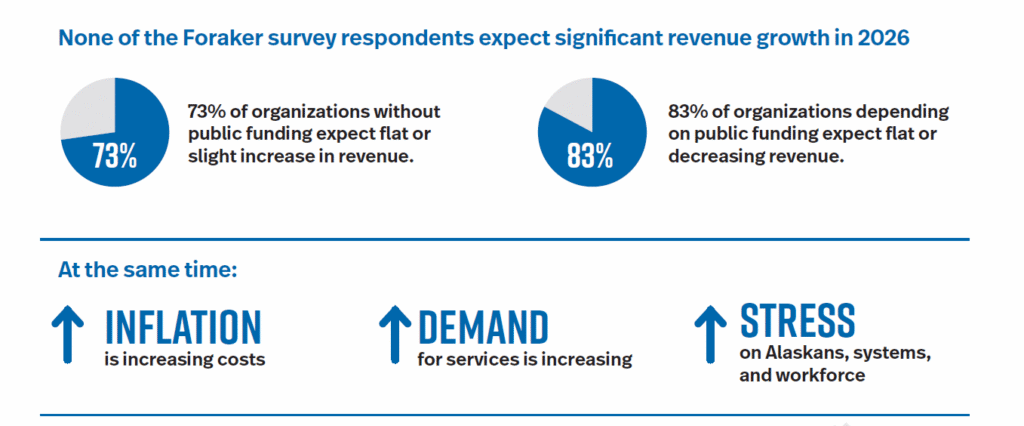
Yet at the same time, none of the Foraker survey respondents expect significant increases in revenue during 2026. While some groups who do not receive public funding expect flat or only slight increases in overall funding, organizations that receive more public funding expect more decreases. At the same time, all these organizations reported cost increases, service demand increases, and an increased amount of stress on Alaskans, the interdependent systems we have created and the nonprofit workforce. The result, in total, is a picture that shows the health and well-being of Alaskans at risk as the impact on our nonprofit sector grows.
All these impacts amount to a “floor is lava game” as the ground beneath us is constantly shifting with new policy and funding mandates, and we collectively hold our breath to see what’s next. Holding our breath creates the kind of quiet that can lead to more exhaustion, and potentially more burn-out.
Take, for example, the overnight decision in mid-January to immediately eliminate $1.3 billion dollars in SAMHSA funding only to have that decision reversed 27 hours later. That decision would have had life or death consequences for the people nonprofits serve and would have meant that many employees would lose their jobs as organizations were forced to close or completely reorganize overnight. As a sector we can rally. We always do and our voices are strong. That is exactly what happened during those 27 hours here in Alaska and across the country, but it came at the cost of unnecessary distraction from mission delivery, high stress, and economic uncertainty. Sadly, this was not an isolated incident, and we expect more to come.
Instead, when we can breathe, we can plan. When we plan, we can adjust. When we adjust, we can talk with each other, and we can use our voices most effectively. This is no different for our sector than any other. We all do better when we are talking to each other and are using reliable, timely, and available information to make decisions like whether we should hire or fire our people, or add, adapt, or shutter our programs, or work better together through new and long-standing partnerships.
As we look forward, the ability to raise our voices is so essential. We know the state and local governments and Alaskans overall need our sector now more than ever to deliver on the promise of the healthcare transformation project, livable and affordable communities, and a workforce ready to take advantage of potential new resource development expansion.
Yet, here we are in uncomfortable silence. Silence in the form of waiting for what’s next. Silence in the form of perseverance. Silence in the form of determination. Silence in the form of feeling overwhelmed and isolated. Whatever the form or the reason, it is time to resurrect our voices.
It will take courage to speak up Still, if we want to come out of this time as strong or stronger in our ability to serve our communities, we must work together every day to lift our voice and the voices all around us.
Today, and tomorrow, and for as long as it takes, it is time to share our stories. It is time to come together and speak our truth. It is time to advocate for the work we do and to share why it matters in our community, our state, and our country. It is time to ask for and offer support to each other as we lift the voices of the sector together.
We can each do our part.
We can use our voice to invest in the work that matters to ourselves, our communities, the state, and this country. We can use our voice to stand up as ambassadors and advocates for nonprofits and the role we play in our communities and for our economy. We can use our voices in collaborations and relationships that advance Alaska and our country. We can use our voice to support our staff, boards, and volunteers. We can use it to keep our government partners at the table. And we can use our voice to be better together.
Let’s hear more from each other. Let’s listen. Let’s lean in. Let’s talk. Let our voices be heard.
-Laurie