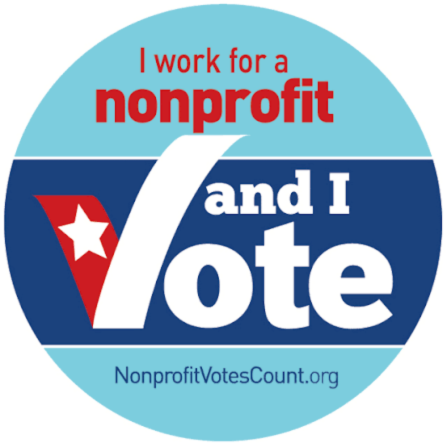
 “I work for a nonprofit and I vote.”
This is my current favorite image—and my social media profile picture right now. It captures something I think people sometimes forget: nonprofit work and civic participation are connected. The work we do, the communities we serve, the boards we sit on, and the choices we make as voters all contribute to the kind of communities we want to live in.
So, what can nonprofits do? Quite a lot.
Many nonpartisan ways are available to nonprofits to encourage every person to exercise their right to vote. Some organize activities like the Get Out the Native Vote, which speaks directly to people to get their voting day plan in place. Others like the national Nonprofit Votes encourages organizations to do their part in removing barriers to full participation. Foraker’s role is generally smaller. We publish a Voter Engagement Guide, and we help nonprofits know the rules and the boundaries of their nonprofit status when it comes to engaging with candidates and issues that matter to mission. Regardless of how we each choose to participate as individuals or organizations, we all have a role to play in encouraging a vibrant and healthy democracy.
Once upon a time, there was a theory that the percentage of voters in Alaska closely matched the percentage of Alaskans willing to serve on a board. This feels like a data point that could be true, but no census data point confirms it. Nevertheless, even at face value, that means our board population could be shrinking along with the number of people who are choosing to exercise their right to vote in our state. We need both to rise for obvious reasons.
We have some tools to help with specific engagement strategies, but there is something larger at play that will require both our attention and deeper conversations on the ways we want to foster civic engagement. For now, in this election season, I invite you to join us as we all do your part, whatever that may be, to foster active civic participation.
If you are ready to use your nonpartisan voice in the next few days or few weeks or few years – great! Your voice matters and people are watching and listening. Pick one. Or pick them all. It will take all of us doing a little to help a lot.
What are some things we can do to get out the vote?
- Connect with your team. Remind them of the mission work they have dedicated their lives to and how that is impacted by their active voter engagement (WITHOUT telling them who to vote for).
- Send an external message soon. Acknowledge that all elections have an impact (positive or challenging) on their community, the organizations they care about, and the people and places where your mission work is active. Tell the truth without hyperbole or partisanship. Our missions are bigger than one person or one election. So above all, offer hope and forward momentum in the form of your mission, just don’t tell them directly or indirectly who to vote for. Encourage everyone to VOTE and to have a plan to vote, whether that be on election day or through an absentee ballot or mail-in ballot. Everyone needs a plan – especially if you are relying on the mail service. Remember that it’s legal for nonprofit 501(c)(3) organizations to encourage everyone to vote. Just steer far away from candidate endorsements.
- Reach out to candidates running for office and those already elected. In Alaska, you know these people. They are accessible at all levels of government, and hearing from you is part of their job and yours. You are on the ground and your voice matters. Importantly, don’t just reach out to one candidate on a specific ticket – you have to talk equally to them all or at least make the effort. If they don’t respond, that is on them – but you have to be certain you tried your best. Also, don’t just talk to them when they are actively running for office, reach out and let them know you appreciate their hard work – even if you don’t agree with every result every time. Civility is a remarkable cure for political division.
- Looking for more ideas? There are lots of ways to engage voters, either on your own or through coalitions and networks. Consider candidate questionnaires, candidate forums, nonpartisan voter registration, voter guides, get-out-the-vote efforts, rides to the polls, candidate visits and education, ballot measure advocacy, or issue advocacy.
- Check these resources:
What are some things we can do with those who are elected?
Regardless of the election’s outcome, it is time now to be ready to engage any person who wins. Decisions are happening around us every day that affect our ability to achieve our missions. Sometimes decisions are made without hearing directly from those who are impacted by them. Using our nonprofit voice can be a bridge to those conversations. We can:
- Let policymakers know about our mission and why we stand for them
- Minimize the impact of “bad” public policy that gets in the way of our success
- Offer “good” public policy that improves our ability to meet mission and their ability to be efficient with the public’s resources
- Provide information that helps policymakers develop the best possible public policies at every level of government
Remember, elected officials generally appreciate any help they can get to do their job well.
Consider how your organization can be ready with a “transition paper” or suggestions that will be mutually beneficial – good for the efficiency and effectiveness of government and good for the mission work you do every day. You can send this to newly elected officials or those who are returning to their job. Or you can share it before the election as long as you send it to all the candidates running for a specific office. If a transition paper seems like too heavy a lift right now, then plan to reach out to new and returning elected officials at all levels of government – local, state, and federal – to say congratulations and thank them for their service, and to offer your services as a resource when they tackle the important policy issues we are all facing as Alaskans and a nation.
Before you take a step, make sure you have a few things in place first.
- Educate the board and your team on the “why” of your document or outreach and your hopes in sharing your nonpartisan nonprofit voice. Make sure you have internal alignment.
- Adopt any internal policies and systems that feel necessary to help you move forward with your nonpartisan advocacy. (Don’t overcomplicate this. Keep it simple so you can keep moving.)
- Engage your public policy committee or create one. This is a great internal sounding board to ensure you stay nonpartisan, focused, and clear in your voice. Ultimately, your board will make the decision, but a committee process can bring huge value and credibility to your process.
- If you have a public policy screen, use it to select the issues you want to focus on. If you don’t have one yet, they are pretty simple to create with your board and committee. This link is a quick resource to get you started or reach out for more help.
- Write your communication and send it along with graciousness and an offer of support to work on the issues together.
At Foraker, we are preparing documents to focus on the vital relationship nonprofits have with government at every level. We will share priorities with them that impact on the sector as a whole. We encourage you to share priorities that impact your specific mission.
What are some things we can do to sustain a culture of advocacy?
Standing for your mission does not have to look one way. And your organization can evolve in your culture of advocacy over time. Consider where your culture is right now and where you want to take it on behalf of your mission. Here are three common advocacy positions. Where are you?
- SILENT ADVOCACY MODE: Keeping your eyes focused on mission and encouraging others to speak up together through coalition work or small, quiet nonpartisan steps that activate and support others with stronger or more honed voices.
- REACTIVE ADVOCACY MODE: Responding to public policy problems only after they are already on local, state, or federal dockets as issues. The challenge here is ramping up quickly enough to respond, but it is effective and possible – especially if you have done the internal alignment work first.
- STRATEGIC ADVOCACY MODE: Getting ahead of the most important issues facing our nonprofit sector (laws, taxes, prompt payment, etc.), sub-sectors (housing, childcare, food security, etc.) or your specific mission work. This can take the form of:
- Preventing ill-advised policies from ever seeing the light of day through quiet diplomacy or strategic early action
- Adjusting regulatory policies to help you better stand for your mission
- Proposing new laws or regulations that improve people’s lives and the communities where they live
Once you are clear in your cultural position, embracing your nonprofit’s inner advocate does not have to be overwhelming. It starts with:
- Understanding what advocacy is and knowing why and how to do it is so important
- Knowing the law and learning about the boundaries of lobbying – a particular kind of advocacy – and the laws that cover it. This will also help alleviate fears and concerns and get clear on your organizational boundaries and the legal rules of engagement. (Not sure what that is? Ask us, we can help.)
- Making an advocacy plan that articulates your position statements and public policy priorities, so your time and money are matched to your capacity to follow through
- Determining your budget of time and money for the long haul
Foraker is your partner now and into the future
You can count on Foraker to be a strong voice for democracy and for the power and strength and passion of the nonprofit sector. You can count on us to deliver transition papers to state and local elected officials. You can count on us to support and elevate solutions that are win-win-win for government, nonprofits, and the people and communities we serve.
We are standing by your side and leading the way together for the benefit of all Alaskans. We are in this together. Let’s all plan to VOTE and then to keep the momentum going.
Laurie
PS. Join us for a nonpartisan election debrief at our regularly scheduled Advocacy in Action on November 10, 2026 at 10:00 am. There might be some unknowns, but we will share with you what we do know. You can register here.
Subscribe to our newsletter: