

Latest news, alerts, and events.
Latest news, alerts, and events.

 What are you hearing? This is a consistent question I am getting. It is a good one because the question in itself tells us a lot about the state many of us are feeling – uncertainty, unpredictability. In 2009, we talked about a “new normal” in reference to the national economy after the downturn in the stock market. Our new normal today is measured more by what we don’t know. We are asking each other “what are you hearing?” I’m asking the same thing from other people. We crave certainty so that we can respond accordingly. Alas, we have a new normal.
That said, one thing I am hearing, which I have been writing about frequently, as have others across the country, is the resurgence of civic engagement.
By sheer numbers, the chances are good that you are engaged in your community. Americans by the thousands are calling, emailing, and writing their elected officials, they are stepping up to volunteer and to donate to the causes that matter the most to them, and they are self-organizing. These are all forms civic engagement – all ways to step in and step up.
What does civic engagement mean? When I searched the web for the definition of civic engagement, I got 3,740,000 results. This seems appropriate as with most things in civil society, the definition is largely in the eyes of the beholder. However, there are a few things I know to be true about any of these definitions: (1) the nonprofit sector is intricately woven within and through the action of civic engagement, and (2) generally speaking, the act of being engaged is a positive sign of democracy in action. Knowing these two things, I willingly jump into invitations to have conversations about how Alaskans can be more connected to their communities.
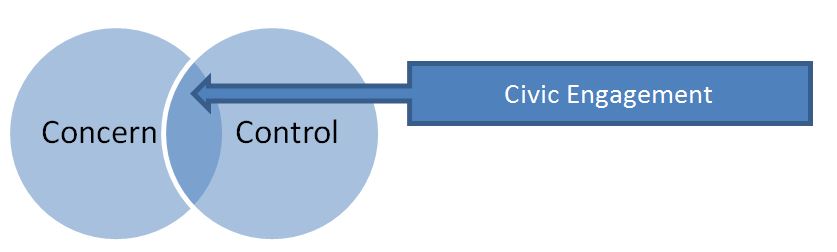
Considering a previous newsletter article I wrote earlier this year about finding focus in one word, I was intrigued when a colleague shared her answer, which was inspired by the work of Stephen Covey, to focusing her civic engagement by explaining a simple Venn diagram. The point of engagement is where one has both concern and the locus of control to have an impact on that concern. This seems like an antidote to the myriad number of issues facing us as a state and a nation. It also seems to address the consistent refrain I hear about how to manage the high level of uncertainty we face as a sector while charting a path forward in a productive way. Placing this idea in my list of highly useful tools, I set out to test the concept.
I can describe my latest encounter on this journey as the “meaningful entertainment” at a house party. This is not how I would normally describe my work. However, in this case the event organizers were a group of young professionals who were ready to do something more meaningful in their community but felt like they needed some additional conversations and process to pick their next step. Yea! They gathered about 30 of their friends and acquaintances for a fun and serious evening. During the course of the evening, I walked them through a process we called Getting Engaged in Your Community: Values-based Volunteerism. I am sharing this with all of you because in the process of creating this experience, I developed a complementary framework to the Venn diagram that seemed to resonate above the din of the Google search definitions and got people in a place where meaningful next steps could occur. I have since shared this a few more times and used it for a handful of facilitated discussions. In each instance, like most things at Foraker, it isn’t overly complicated but when pondered it can offer many levels of consideration. Here is the framework:
Civic Engagement – Places and Action
A few thoughts about this list:
Democracy and our civil society are at their best when we engage our whole self – when we find that place where we can be active and be heard. Throughout this newsetter and through our blogs this month we are highlighting several ways for you to consider finding that connection between concern and control and engaging in a way that works for you. These include using your voice and walking with your feet and taking action. Will you do them all? Join us.
There are so many ways to engage. And we can each find our own way to take action in the new normal of uncertainty. The trick is to discover what works for you – what brings you certainty that you are finding the place where your concerns and your control meet. I hope you will take some of the steps I have offered. If not, I hope you will share what action you will take next. Effective civic engagement requires all of us to take part.