As your state nonprofit association, we are here to provide resources to strengthen your organization.
As your state nonprofit association, we are here to provide resources to strengthen your organization.
Adapted from the article Choose More Money for More Mission by Laurie Wolf, CFRE, MNPL, President & CEO, The Foraker Group
There are a number of versions of this tool*, including The Matrix Map created by Jeanne Bell and Steve Zimmerman. At Foraker, we adapted it to work into our sustainability framework to keep you focused on the greatest return on your investment of time and resources for both revenue and mission.
What is it?
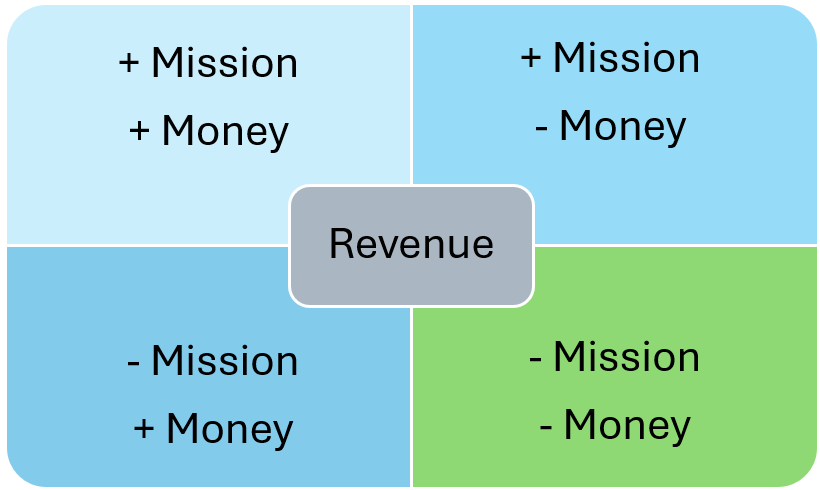
The money-mission matrix is comprised of four quadrants. As the diagram we use shows, it is a simple layout that articulates pluses and minuses next to the words mission and money. Mission in this case can stand literally for the words in your mission statement or can be even more focused by using your core purpose and core values. You can also expand the idea to encapsulate your current strategic goals or theory of change to ensure alignment.
The “money” reference can be tricky. It can be most helpful to talk about unrestricted operating cash and preferably to focus on the profit-making potential or reality of the activity you place in the matrix. Note that this requires truth-telling and likely some well-articulated financial statements that capture the true costs and the true income. This is no small feat for many organizations where passion and excitement and/or any emotional response, rather than facts, drive a lot of decisions. (Up the ante even more on this last comment when we are talking about deciding whether to do or not to do another special event.)
How to use it
Having a clear sense of your business model is an essential step. Start by establishing if your organization is primarily powered by earned income or charitable income. Then choose among the various opportunities that will fit this model, all while staying true to mission.
Set some ground rules to make sure you are getting the conversations and decisions you need from using this diagram. Here are a few to get you started:
Once you have laid out your matrix and set your ground rules, there is just a little bit more to know about the quadrants in order to generate rich dialogue.
Filling in the boxes is a lesson in facilitation. There are many ways to go about doing it, and so much depends on where you want the conversation to flow from and to. For singular projects, events, or activities, we encourage a big group conversation where the topic is presented, and the debate and discussion ensue to place it in the right quadrant. The gift is a dialog. The goal is consensus about where it goes, and most importantly why it goes there. Then there are the choices about what to do next that come after it is categorized and that build from the conversation. For example, if the group is debating a fundraising special event, the likelihood that it lives in the top row is low – yes, there are exceptions, but they are few.
It is critical that as a team you follow the ground rules. Listen to each other, examine the facts, including the science of fundraising, and together decide what to do no matter where it lives in the matrix. If you find it lives in “plus mission, minus money,” then discuss what you could do to shift the money piece, like seeing it as step in the donor cycle with a more significant financial ask to the donor outside the event. If it lives in “plus money, minus mission,” then consider what you can do at the event to connect donors to a mission experience or make an emotional connection through stories etc. See the next step as an opportunity to move activities one box closer to “plus mission, plus money” nirvana.
You can also use the matrix to focus on more than one effort at a time. To do this, consider all the major organizational activities, or only those of the board, or only those that are attached to the revenue line in the budget, which could mean talking about both earned income and charitable income. In these more global discussions, I suggest starting with smaller group discussions about the right category, then enlarging into a big group to compare and contrast. Finding smaller group consensus will help more voices be heard and allow for a deeper dive into the ideas. This likely means more clarity by the time the conversation comes back to the larger group.
Whichever path you choose to fill in the matrix, know that the gift is the conversation itself. Therein lies the place where assumptions are clarified, myths are revealed, and decisions are made. Ultimately, this tool is about gaining understanding and honest dialogue. It is as Jim Collins advises, an opportunity to “confront the brutal facts” in order to move forward in talking about how we spend our time, and where we find both joy and results in the work. Ultimately, the results should bring each organization one step closer to more money for more mission.
*There are many versions of the Mission-Money Matrix but little credit to who originated the idea. A quick Google search yields the variations and some classes on YouTube, but not even Wikipedia knows the source. Whoever you are, thank you for the original idea that we have adapted.